Blooming
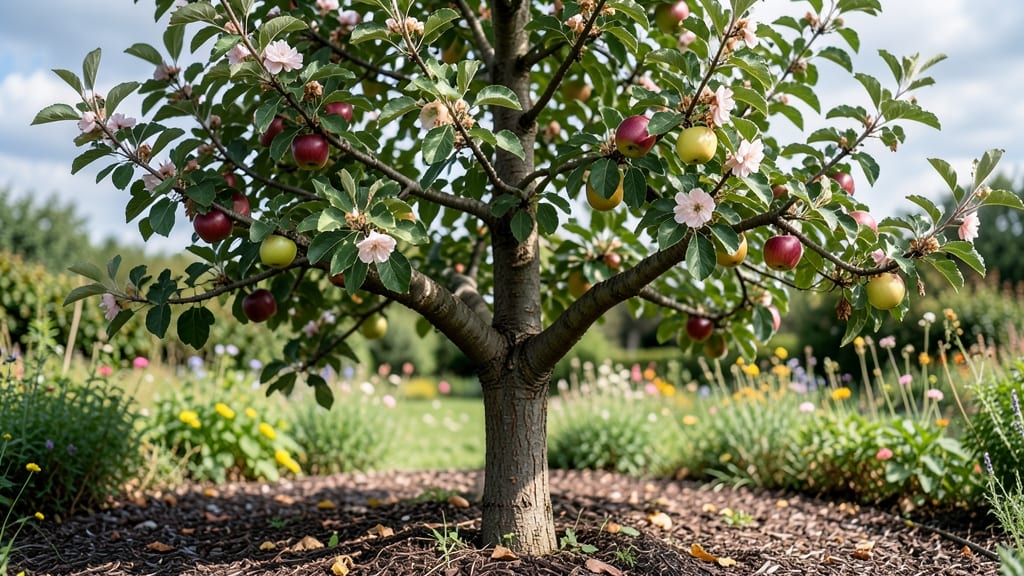
How long until an apple tree produces fruit depends on the variety, with most trees bearing fruit between 3 to 5 years after planting, while dwarf varieties can fruit in as little as 2 years and standard trees may take 5 to 7 years depending on growing conditions.
Patience is key when growing apple trees, but the timeline varies dramatically based on the rootstock and growing conditions. 🍎 Dwarf varieties like 'Columnar' or 'Semi-Dwarf' trees are bred to fruit faster because their smaller size allows for quicker maturation of the root and canopy systems.
Meanwhile, full-sized trees take longer because they need to establish a larger root network and structural framework first. Even within the same variety, factors like soil fertility, sunlight exposure, and consistent watering can shave off months—or even a full year—from the fruiting timeline.
For example, if you plant a 'Honeycrisp' apple tree on a dwarf rootstock in a sunny, well-drained location, you might see your first harvest in just 2-3 years.
However, if you plant the same variety in a cooler climate or with poor soil quality, it could take closer to 5 years. Proper pruning and fertilization during the early years also play a critical role in encouraging early fruiting.
💡 In This Article
- Factors That Affect Apple Tree Fruit Production Timeline
- Fastest-Bearing Apple Tree Varieties for Home Gardens
Factors that affect apple tree fruit production timeline
The rootstock you choose is the single most critical factor in determining how quickly your apple tree will bear fruit. Rootstocks are the underlying tree onto which the desired apple variety (scion) is grafted, and they control both the tree's size and its growth rate.
Dwarf rootstocks like M.9 or B.9 produce trees that mature in 2-3 years, while semi-dwarf rootstocks like MM.106 take 3-4 years.
Standard rootstocks, such as Seedling or Antonovka, can delay fruiting until 5-7 years because they require more time to develop a robust root system and structural framework.
Pollination needs also play a surprising role. Many apple varieties require cross-pollination from a different apple tree to produce fruit, which means planting two compatible varieties within 50-100 feet of each other.
Some varieties, like 'Liberty' or 'Enterprise,' are self-pollinating and can fruit reliably on their own, but they still may take slightly longer to establish. Additionally, apple trees need a period of cold dormancy—typically 400-800 hours below 45°F—to trigger flowering.
In warmer climates where this requirement isn't met, fruiting can be delayed or inconsistent.
Soil quality and fertility are often underestimated but equally important. Apple trees thrive in well-draining, slightly acidic soil (pH 6.0-7.0) rich in organic matter. Poor soil quality forces the tree to divert energy toward root and leaf growth rather than fruit production.
For example, a tree planted in heavy clay soil may take an extra year or more to fruit compared to one in loamy, nutrient-rich soil. Regular soil testing and amendments with compost or balanced fertilizers can accelerate the fruiting timeline by 12-18 months.
Sunlight exposure is another non-negotiable factor—apple trees need 6-8 hours of direct sunlight daily to produce fruit. Inadequate light weakens the tree's ability to photosynthesize, reducing energy available for flowering and fruiting.
Even in ideal conditions, young trees prioritize vegetative growth (leaves, branches) over fruit production until they reach a critical size, which explains why dwarf trees fruit faster—they reach this threshold sooner.
Watering practices also influence the timeline. Consistent moisture is essential, especially during the first 2-3 years when the tree establishes its root system. Drought stress can stunt growth and delay fruiting by up to 1-2 years, while overwatering can lead to root rot.
Mulching around the base of the tree helps retain moisture and regulate soil temperature, creating optimal conditions for early fruiting.
Finally, pruning techniques matter. Proper pruning encourages a balanced canopy and directs energy toward fruit production. Young trees should be pruned to remove competing branches and promote an open center, which allows sunlight to penetrate deeper. Without this, the tree may take longer to mature and bear fruit.
For instance, a well-pruned Gala tree on a dwarf rootstock might fruit in 2 years, while an unpruned one could take 4 years.