Light Requirements
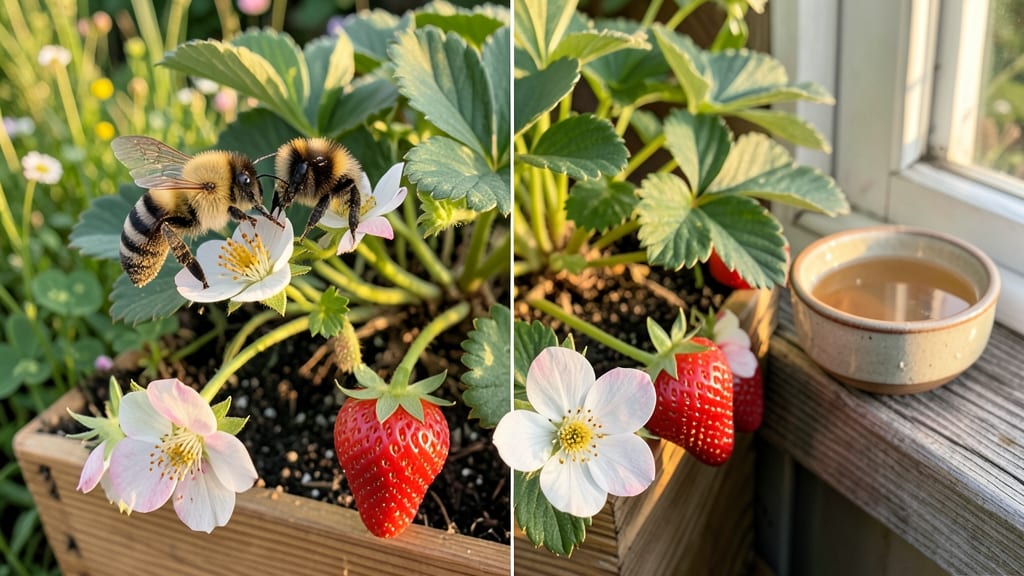
Strawberries don't strictly need pollinators to produce fruit since they self-pollinate, but bees and other pollinators dramatically enhance fruit quality by cross-pollinating flowers. This process boosts size, sweetness, and overall yield, especially in wild varieties.
Strawberries have a clever trick up their leafy sleeves—they're hermaphroditic, meaning each flower contains both male and female parts.
This allows them to self-pollinate when wind or even gentle shaking transfers pollen within the same blossom. 🌱 However, when pollinators like bees visit, they carry pollen between different flowers, creating stronger genetic diversity that results in plumper, sweeter berries.
This is why commercial growers often rely on bee colonies to maximize their harvests.
For home gardeners, you can mimic nature's process by giving your strawberry plants a little help. Try gently shaking the plants when they're in bloom to encourage self-pollination, or use a small paintbrush to transfer pollen between flowers.
Planting varieties like Jewel or Chandler, known for their self-sufficiency, can also improve your chances of a bountiful harvest without relying solely on pollinators.
💡 In This Article
- How Strawberry Self-Pollination Works Naturally
- Boosting Strawberry Fruit Production Without Pollinators
How strawberry self-pollination works naturally
The secret behind strawberries' ability to produce fruit without pollinators lies in their unique flower structure. Each strawberry flower contains both male (anthers) and female (pistil) reproductive parts, making them perfect flowers.
When wind, rain, or even the plant's natural movement shakes the blossoms, pollen from the anthers lands on the stigma of the same flower, triggering fertilization. This process, called autogamy, allows strawberries to self-pollinate efficiently—though typically at 50-70% effectiveness compared to cross-pollination.
What makes this fascinating is the botanical timing: strawberry flowers open in the morning when humidity is high, creating ideal conditions for pollen to stick to the stigma.
The flower's curved shape also helps direct pollen downward toward the receptive female parts. 🌸 However, this self-pollination often results in smaller berries with fewer seeds because the genetic diversity is limited.
In contrast, cross-pollination by bees transfers pollen between different plants, creating fruits that are 20-30% larger and packed with more flavorful seeds.
The genetic impact of pollination methods becomes visible in the fruit's development. Self-pollinated strawberries typically develop 10-15 seeds per berry, while cross-pollinated varieties can have 30-50 seeds. Each seed represents a potential embryo, so more seeds mean more opportunities for the plant to invest in fruit growth.
This is why commercial growers often use bee colonies—each bee can visit up to 5,000 flowers per day, dramatically increasing both quantity and quality of the harvest.
Interestingly, strawberry plants have evolved different strategies based on their environment. Wild strawberries, which grow in scattered patches, rely heavily on pollinators because their flowers are spaced far apart. In contrast, cultivated varieties are bred to have flowers clustered together, making self-pollination more efficient.
This adaptation explains why garden strawberries often produce fruit even when bees are scarce, while their wild relatives struggle without pollinator assistance.
For those curious about the science, the fertilization process begins when pollen grains land on the stigma and germinate, forming pollen tubes that grow down through the style to the ovary. Once the sperm cells reach the ovules, fertilization occurs within 24-48 hours.
The ovary then begins swelling, and within 3-4 weeks, a fully formed strawberry emerges. This rapid development is one reason why strawberries are so responsive to pollination methods—small changes in pollen transfer can lead to noticeable differences in fruit size and sweetness.
Consider this comparison: a self-pollinated strawberry might weigh 10-15 grams, while a cross-pollinated berry from the same plant could reach 20-30 grams. The difference isn't just in size but also in sugar content—cross-pollinated berries often have 10-20% more soluble solids, making them sweeter and more flavorful.
This explains why many gardeners notice their strawberries taste "blah" during years with poor pollinator activity.
What most people don't realize is that strawberries have a backup system when pollinators are absent. If fertilization doesn't occur through natural means, some varieties can still develop parthenocarpic fruit—seedless berries that form without pollination.
While these fruits are smaller and less flavorful, they demonstrate how resilient strawberry plants can be. 🌱 This ability to produce fruit through multiple pathways is one reason strawberries are such a hardy and adaptable crop.