
Trees
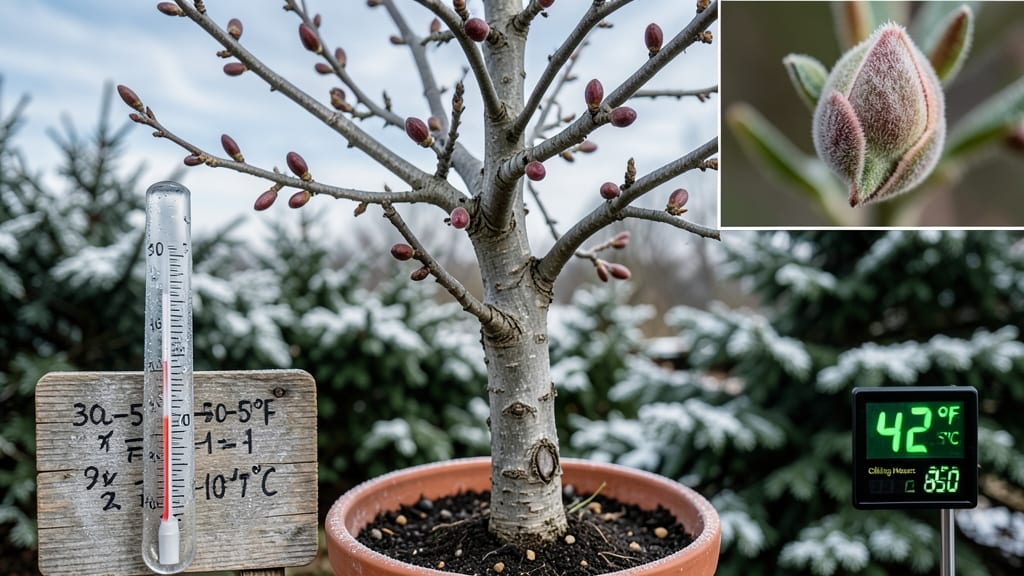
Chilling hours for fruit trees are the total accumulated hours below 45°F (7°C) that trees need each winter to break dormancy and trigger healthy spring blooming and fruit production. Requirements vary by species, typically ranging from 200 to 1,200 hours annually.
Chilling hours are essentially the "cold shock" fruit trees need to wake up from winter dormancy. 🌳 When temperatures drop below 45°F (7°C) for extended periods, it signals the tree to stop producing growth hormones and prepare for spring.
Without enough chilling, trees may bloom late, produce poor-quality fruit, or even fail to flower at all. For example, peaches usually need 500–800 hours, while apples can handle 800–1,200 hours, which is why climate matters so much when choosing varieties.
Understanding your local chilling hours helps you pick the right trees for your garden. In warmer regions, you might opt for low-chill varieties like figs or loquats, which thrive with as few as 200–300 hours.
Meanwhile, in colder zones, traditional cherries or plums with higher chilling needs will flourish. Always check your USDA hardiness zone and local weather data to make the best choice!
💡 In This Article
- How Chilling Hours Work in Fruit Tree Dormancy
- Choosing Fruit Trees Based on Your Climate’s Chilling Hours
How chilling hours work in fruit tree dormancy
Fruit trees enter dormancy in late fall when temperatures drop, halting growth and conserving energy. During this phase, cold temperatures trigger a biological process called endodormancy, where the tree’s internal clock resets.
This is controlled by hormones like abscisic acid (ABA), which accumulates in response to prolonged cold exposure below 45°F (7°C). Think of it like a natural alarm clock—without enough chilling, the tree stays "asleep" and misses its cue to bloom in spring. 🌱
The magic happens when the tree accumulates enough chilling hours, typically between 200–1,200 hours, depending on the species. For example, peaches need around 500–800 hours to break dormancy, while apples require 800–1,200 hours. If temperatures fluctuate above 45°F (7°C) too often, the tree’s internal counter resets, delaying blooming.
This is why some years, despite mild winters, fruit trees may bloom late or poorly—it’s not just about the coldest days but the consistent accumulation of chilling hours.
Once the tree has met its chilling requirement, it transitions to ecodormancy, where it’s still dormant but responsive to warmer spring temperatures. This phase is critical for bud development and flower formation. Without sufficient chilling, buds may fail to open, leading to sparse or no fruit production.
For instance, a cherry tree in a warm climate might bloom but produce tiny, poor-quality fruit—or worse, no fruit at all—because it didn’t get enough cold exposure to trigger healthy growth hormones. 🍒
Temperature thresholds matter too. Most fruit trees need consistent cold, but some varieties can handle brief warm spells. For example, low-chill varieties like figs or olives thrive with as few as 200–300 hours, making them ideal for Mediterranean climates.
Meanwhile, high-chill varieties like apricots or plums need 600–1,000 hours to perform well. Even a few degrees above 45°F (7°C) can disrupt the process, so microclimates (like urban heat islands) can significantly impact chilling accumulation.
Seasonal variations also play a role. Early winter chilling is often more effective than late winter, as the tree’s metabolic state changes. For example, a 20°F (-7°C) night in December might count more toward a tree’s chilling requirement than a 40°F (4°C) night in February.
This is why gardeners in marginal climates sometimes use techniques like artificial chilling (e.g., cold storage for potted trees) or choose varieties bred for their specific zone. 🌡️
What most people don’t realize is that too much chilling can also cause problems. While most fruit trees tolerate extra cold, some varieties (like low-chill peaches) may suffer from chilling injury, where excessive cold damages buds or branches.
This is why matching the tree to your climate—and avoiding extreme fluctuations—is key to success. For example, a 500-hour peach tree planted in a 1,000-hour zone might still produce fruit, but the quality could suffer compared to a perfectly matched variety.